The purpose of this lesson is to introduce 4th graders to using their imagination to create a drawing through random lines. This allows students to visualize small or big lines as a starting point and continue to draw a picture. This age will become more aware of the differences in figures and objects. They will also be able to realize everyone has different imaginations and will create something unique in their own way.
Extension Activity:
This project would work well with Language Arts because the students could write a story that goes with their drawing. As 4th graders, they would be able to make up some pretty great stories using their imagination. Once everyone is done with their project and story, students can present them to the class.
Thursday, March 28, 2013

Easter Egg Painting
The purpose of this lesson is to introduce kindergarten to certain elements of design that they will be using for their project. The students will be able to create their own patterns using colors (warm/cool and light/dark), lines, and shapes to express their own creativity on 3 eggs.

Extension Activity:
I would like to teach lower elementary and this would be a great project for them to express themselves using pattern. You can also use this project in science by showing your students that an egg can fit through a pop bottle. Place the bottle (without the egg on top) in a bowl of hot water for 5 minutes, then place it in a bowl of ice cold water. Wet the egg and place it on top of the bottle and watch the egg fall because the air in the bottle cools down. Your students will be absolutely stunned at the fact that the egg fit through the top of the bottle without breaking!
Thursday, March 21, 2013
Hidden Safari
The purpose of this project is to introduce lower grades to warm and cool colors. This project also demonstrates how to draw in a different way--upside down. Drawing upside down will help students with size relationships, as well as details that they would usually omit. This is a great way to introduce new ways of drawing to students because they should be taught many methods.


Extension Activity:
This project would work well in a science lesson by going more in depth into different safari animals. Each student can look up more information about the animal they drew, such as their habitat, their diet, and more. The students can describe characteristics of their animals and have their class try to guess what animal they had. All the students can wear their Ruby Red Glasses to view the student's drawing.
Extension Activity:
This project would work well in a science lesson by going more in depth into different safari animals. Each student can look up more information about the animal they drew, such as their habitat, their diet, and more. The students can describe characteristics of their animals and have their class try to guess what animal they had. All the students can wear their Ruby Red Glasses to view the student's drawing.
Thursday, March 14, 2013
Storybook Illustration-- Eric Carle
This storybook illustration project, similar to the work done by Eric Carle, is a great way for students to use their unique creativity to develop a story of their own. For this project, students needed to paint large pieces of paper with different designs (swirls, strokes, etc.) and of different colors. Then they drew a scene with simple characteristics, that would later be cut out of the painted paper.


Extension Activity:
I would use this as a Language Arts project as well. Since this storybook illustration is more towards the beginning, middle, or end of a story, I would have my students write the rest of the story. For example, if their illustration is in the middle, they will need to write the beginning and the end of their story. Their illustration will help them get a visual of their story, then be able to expand their imagination and finish a whole storybook.
Thursday, February 14, 2013
Implementing Art History
There are so many ways to implement art history into your classroom. You can do the Vincent van Gogh "Starry Night" Collage that I posted earlier, but there are many more. As a 6th grader I remember doing a Michelangelo project where we created our own version of the Sistine Chapel's ceiling. We took time during Social Studies for a couple days drawing on a piece of paper under our desks/chairs while laying on our backs. It was a great experience because we were able to relate to how much time it can take to create something above your head.


"Starry Night" Tissue Paper Collage
For this project we were to create our own version of Vincent van Gogh's "Starry Night" using construction paper, tissue paper, paint brush, gel medium, glue (stick/bottle), and sharpies (regular/metallic).
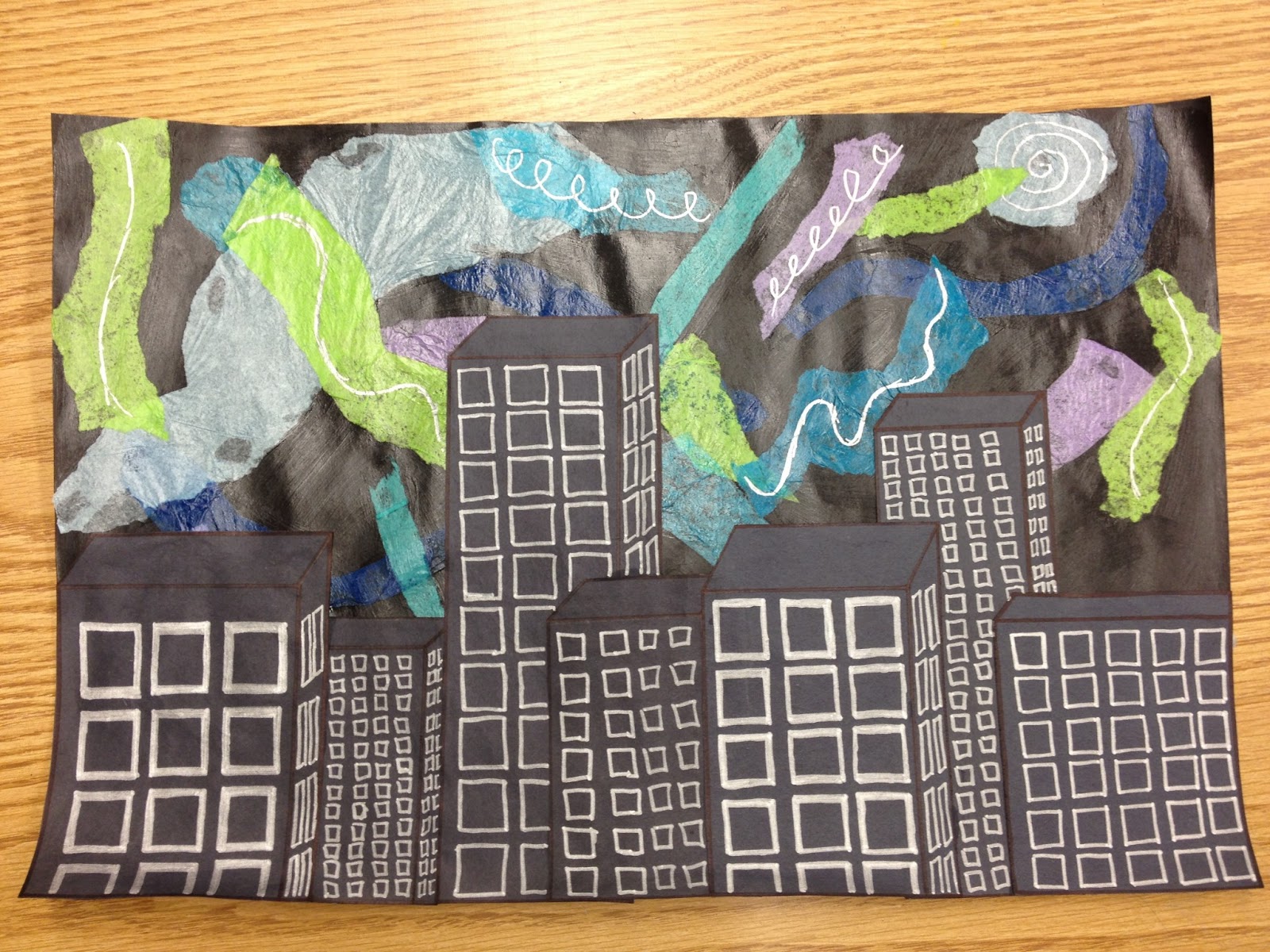
I hope to teach K-2nd grade, so this exact project might be to difficult for them. For their age I would prefer doing a project similar, using finger paints instead of tissue paper/gel medium. This way they'll be able to use their fingers and not have to worry about their tissue paper moving all over the place when they painting on the gel medium. When it comes to doing the landscape I would have them draw rectangles/squares for the buildings, keeping it simple enough for them.
Friday, February 8, 2013
Scavenger Hunt
The purpose of this Scavenger Hunt is to allow your students to use a camera to capture the different Elements of Art and Principles of Design that they see in their everyday life. It's a great way to get them out of the classroom and to begin recognizing the elements/principles.


.jpg)


This bench in Aberdeen represents one of the Elements of Art, "Value", showing range between light and dark.

These mirrored candles in my basement represent one of the Principles of Design, "Balance", showing symmetry.

This snail in an aquarium represents one of the Principles of Design, "Emphasis", showing the snail in focus while the background is blurry.
.jpg)
This sunset in Harding County represents one of the Principles of Design, "Contrast", showing the difference in colors (light and dark).

My friends Shelby and Callie ice skating represent one of the Principles of Design, "Rhythm/Movement", showing visual movement of the subject.
Subscribe to:
Posts (Atom)